
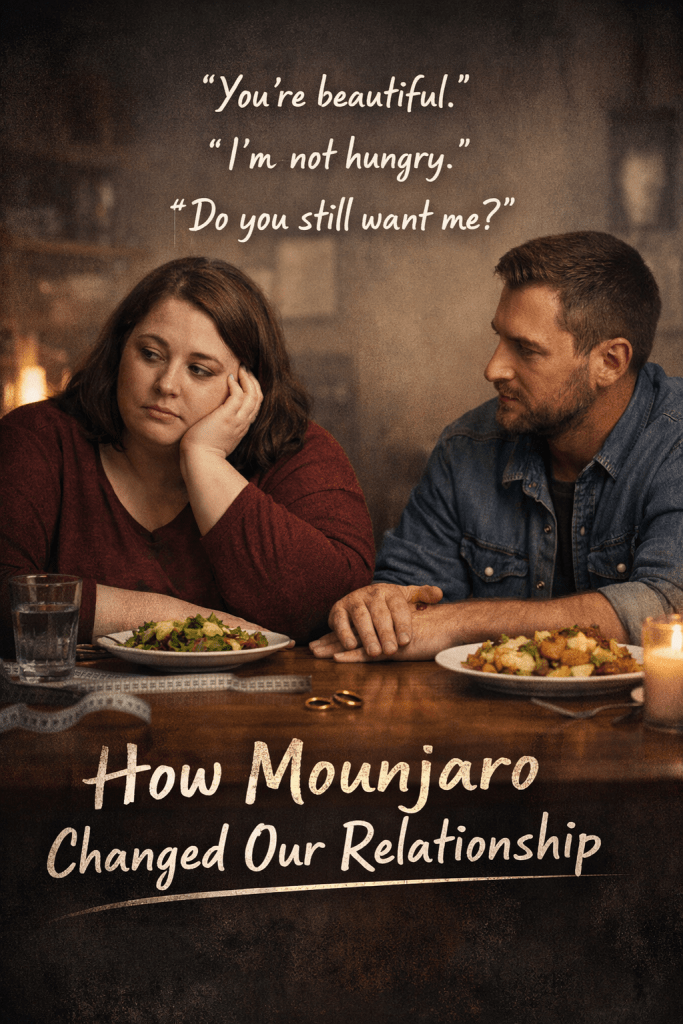
I didn’t expect Mounjaro to change my relationship.
I expected the weight loss.
I expected the smaller portions.
I expected the quieter mind around food.
What I didn’t expect was how it would feel to sit across from the person I love… and not want to eat.
When Hunger Disappears
Mounjaro works by mimicking hormones like GLP-1 and GIP. It slows digestion. It regulates blood sugar. It reduces appetite. For many of us who have lived our entire lives in a body that felt constantly hungry, it feels like peace.
But here’s the complicated part:
Food isn’t just fuel in a relationship.
It’s connection.
It’s Friday night takeaways.
It’s Sunday roast.
It’s “Shall we grab something?” after a long day.
It’s sharing dessert with two spoons.
And suddenly, I’m full after four bites.
My partner looks at me and says,
“Are you sure you don’t want more?”
“Are you okay?”
“You’ve hardly eaten.”
And I can see it in their eyes — confusion. Worry. Sometimes even rejection.
Because when you’ve always bonded through food, appetite becomes emotional currency.
The Guilt of Being the One Who Changes
When you lose weight in a relationship, something shifts.
Even if your partner says they love you at any size.
Even if they’ve supported you every step of the way.
Even if they reassure you constantly.
There’s a quiet grief.
They may feel:
- Left behind
- Worried you’ll outgrow them
- Afraid your confidence will change the dynamic
- Unsure how to support something they don’t physically feel
And you may feel:
- Guilty for eating less
- Guilty for wanting to change
- Guilty for liking the changes
- Guilty for not believing their reassurance
Because here’s the truth no one talks about:
When you’ve been overweight your whole life, you don’t just carry weight on your body.
You carry it in your identity.
“You’re Beautiful” — Why I Don’t Believe You
My partner tells me I’m beautiful.
He always has.
Before Mounjaro.
Before weight loss.
Before the confidence started flickering into existence.
But when you’ve lived years — sometimes decades — in a bigger body, you build armour.
You don’t trust compliments.
You assume attraction is compromise.
You think reassurance is kindness, not truth.
So when they say,
“I loved you before and I love you now,”
there’s a part of me that whispers:
You’re just saying that.
Not because I don’t love them.
But because I never learned to love me.
And that’s the real shift Mounjaro can trigger.
It changes your body — yes.
But it also forces you to confront the story you’ve told yourself about your worth.
Intimacy in a Changing Body
Being overweight in a relationship affects intimacy more than we admit.
You:
- Avoid certain positions
- Hide under covers
- Keep the lights off
- Tense when touched in “that” area
- Apologise for your body without saying the words
Even if your partner doesn’t see what you see.
Even if they genuinely desire you.
Your mind can override their affection.
And then weight loss begins.
Clothes fit differently.
Your stomach isn’t the first thing you feel when you lie down.
Your body moves differently during intimate moments.
But here’s the twist:
Confidence doesn’t automatically arrive with weight loss.
Sometimes insecurity gets louder.
“Do I look smaller?”
“Can they tell?”
“Do they prefer me thinner?”
“Were they settling before?”
It’s exhausting.
For both of you.
The Partner Who Doesn’t Know How to Help
Your partner might feel helpless.
They can’t feel your appetite disappearing.
They can’t feel the hormonal shifts.
They can’t feel the mental rewiring happening around food.
All they see is:
- You pushing the plate away
- You shrinking physically
- You questioning yourself
- You not believing them
They try to reassure you.
They say:
“I love you.”
“You look amazing.”
“I’m proud of you.”
And sometimes you nod.
But inside, the little overweight child in you still thinks:
I’m not enough yet.
Relationships Need Recalibrating
Mounjaro doesn’t just change metabolism.
It changes dynamics.
You may need to:
- Find new ways to connect that don’t revolve around food
- Communicate openly about fears
- Reassure each other — not just one way
- Grieve the old version of yourselves together
Because weight loss isn’t just physical.
It’s emotional evolution.
And evolution is uncomfortable.
If You’re the One Taking Mounjaro
Be gentle with yourself.
You are allowed to:
- Want health
- Want change
- Enjoy progress
- Still struggle mentally
- Still feel insecure
Weight loss does not instantly rewrite a lifetime of self-perception.
Therapy helps. Honest conversations help. Naming the fear helps.
If You’re the Partner
Understand this:
They’re not rejecting you when they don’t eat.
They’re not disbelieving you to hurt you.
They’re not changing because they love you less.
They’re navigating a body that finally feels different.
That’s huge.
Sometimes the most powerful reassurance isn’t:
“You’re beautiful.”
It’s:
“I’m not going anywhere.”
Love After Appetite
Mounjaro quieted my hunger.
But it amplified something else — vulnerability.
It forced conversations we’d never had.
It exposed insecurities I’d buried.
It changed how we eat, how we see each other, how we touch.
And maybe that’s not a threat.
Maybe it’s growth.
Because real love isn’t about matching portion sizes.
It’s about staying at the table — even when everything else changes.

 May Contain Chocolate
Leave a comment